
Key Takeaways
- A chatbot answers questions inside a conversation. An AI agent plans steps and acts, such as updating a record or sending a confirmed booking, not just describing what to do.
- Most "chatbots" that only read from a knowledge base are not agents. The line is whether the system can safely take an action, not how fluent its replies sound.
- Agents need clear limits: which actions they may take unsupervised, which need approval, and what happens when the model is unsure.
- Many businesses move from a chatbot to agent-style automation in stages, starting with read-only answers before any system is allowed to write data.
In the rapidly advancing landscape of generative artificial intelligence, few terms are conflated as frequently as "chatbot" and "AI agent." Business leaders evaluating automation software are routinely pitched chatbots dressed up as agents, or cautioned against agentic risks when all they need is a reliable customer service FAQ responder. Understanding the architectural boundary between conversational dialogue and autonomous execution is essential for making informed technology investments.
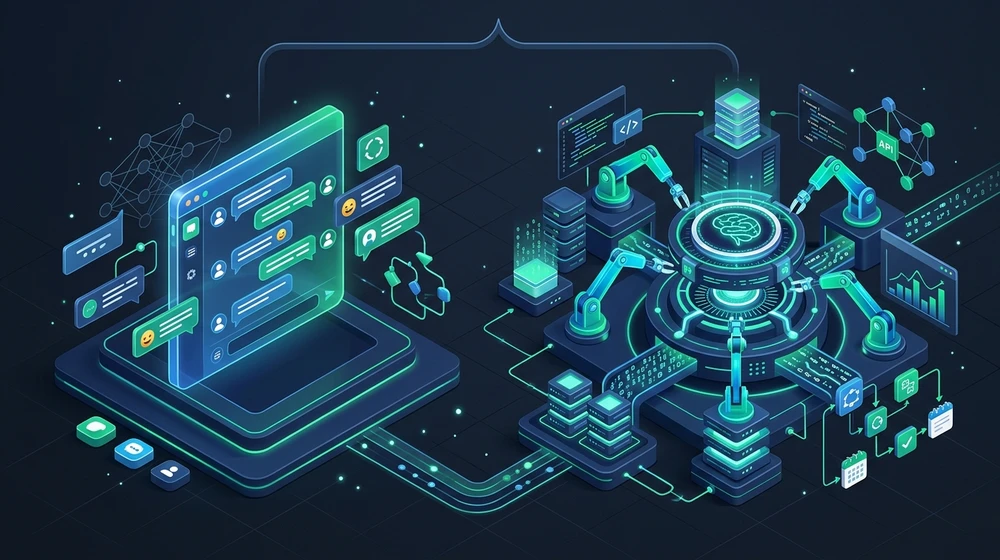
At its core, the distinction is straightforward: chatbots talk, while AI agents act. While a traditional or LLM-powered chatbot synthesizes answers to user questions within a messaging window, an autonomous AI agent formulates multi-step execution plans, connects directly to enterprise tools and APIs, reads and updates external databases, and independently drives complex business processes to completion.
Through our specialized AI automation agency services, Sivaga Technologies helps modern enterprises bridge this gap, migrating static chat interfaces into proactive, autonomous agent networks that actively drive operational productivity.
High-Level Architectural Comparison
To understand why AI agents represent a generational leap in software capability, consider how each paradigm processes user intent:
| Operational Dimension | Conversational Chatbot | Autonomous AI Agent |
|---|---|---|
| Primary Objective | Generate human-like text responses and answer questions | Achieve an open-ended business goal through multi-step actions |
| Control Flow | Turn-based reactive (User asks prompt, bot answers) | Autonomous loop (Agent plans, acts, observes, and self-corrects) |
| Tool & API Integration | Minimal or read-only (Retrieval-Augmented Generation / RAG) | Comprehensive read/write (REST APIs, databases, code execution, web scraping) |
| State & Memory | Ephemeral conversation history limited by context window | Persistent state machines, episodic memory, vector knowledge stores |
| Human Involvement | Continuous (Human guides every step of the conversation) | Supervisory / Human-in-the-Loop (Agent alerts human only on high-risk approvals) |
What Is a Chatbot? (The Information Interface)
A chatbot is a software application designed to simulate human dialogue via voice or text. Chatbots fall broadly into two generations:
1. Rule-Based / Scripted Chatbots
Early conversational bots operate on rigid decision trees and pattern matching. When a user selects "Track My Order" or types a keyword, the bot matches the intent against hardcoded responses. If the user departs from the expected script, the bot fails and requests human agent handoff.
2. Generative AI / RAG Chatbots
Modern chatbots utilize Large Language Models (such as GPT-4o, Claude 3.5 Haiku, or open-source Llama 3 models) augmented with Retrieval-Augmented Generation (RAG). When a user asks a complex question, the bot retrieves relevant passages from an internal vector knowledge base (like company policies, user manuals, or knowledge bases) and generates a polished, context-aware answer.
The Core Boundary of a Chatbot: Despite their conversational fluidity, chatbots remain passive information interfaces. If a customer asks, "How do I update my billing credit card?", an enterprise chatbot will provide a clear, step-by-step tutorial. But it will not log into the payment gateway, update the card token, verify authorization with Stripe, and email an updated invoice to accounting. For that, you need an AI agent.
What Is an AI Agent? (The Autonomous Operator)
An AI agent is an autonomous software entity designed to perceive its operating environment, make independent reasoning decisions, invoke software tools, and execute sequential actions to accomplish a defined business objective with minimal human steering.
The Anatomy of an Agent: Core Architectural Pillars
An AI agent is composed of four interlocking architectural subsystems:
- The Cognitive Core (LLM Reasoning): Acts as the central processing unit. The model evaluates user goals, analyzes environmental feedback, breaks complex problems into sub-tasks, and decides which steps to take next.
- Planning and Reflection Engine: Employs structured prompting architectures such as ReAct (Reason + Act), Plan-and-Solve, or Reflexion. The agent continuously compares its current state against the end goal, detects errors, and revises its plan in real time.
- Tool Capability Registry: Provides the agent with hands to interact with the world. Tools are formally declared JSON schemas representing API endpoints, database queries, web browsers, calculators, or terminal commands. The agent dynamically outputs parameters to call these functions.
- Stateful Memory Hierarchy:
- Short-Term Memory: Contextual working memory tracking current multi-step reasoning thoughts.
- Long-Term Memory: Vector databases storing past task completions, enterprise knowledge, and historical user preferences.
- Entity Memory: Structured relational state tracking transaction statuses and session variables across days or weeks.
Chatbot Scenario: User asks: "Are there any server outages?" Chatbot checks status page API, replies: "Yes, database cluster us-east-1 is experiencing 98% memory pressure and high latency."
AI Agent Scenario: Same notification triggers the AI Agent. The agent runs diagnostic scripts, analyzes error logs, identifies a stuck indexing job, terminates the query, scales the replica pool, verifies latency returns below 50ms, posts a post-mortem summary to Slack, and logs an incident ticket in Jira.
Direct Feature Comparison: Chatbots vs AI Agents
The following detailed technical breakdown illustrates how chatbots and AI agents compare across enterprise implementation categories:
| Technical Capability | Conversational Chatbot | Autonomous AI Agent |
|---|---|---|
| Initiative | Purely reactive. Only operates when a human initiates a chat prompt. | Proactive and event-driven. Can trigger on webhooks, cron timers, log alerts, or user prompts. |
| Multi-Step Problem Solving | Single-turn or basic dialogue chain. Struggles with interdependent procedural tasks. | Deconstructs complex goals into dozens of ordered sub-tasks and executes them sequentially or in parallel. |
| System Write Operations | Rare. Generally restricted to read-only knowledge retrieval to mitigate security risk. | Core feature. Updates databases, modifies code, triggers bank wires, and creates records via authenticated APIs. |
| Error Handling | Apologizes to the user and suggests rephrasing or contacting support. | Inspects stack traces, adjusts payload schemas, queries alternative endpoints, and retries. |
| Multi-Agent Collaboration | Not applicable. Operates as a standalone single-prompt dialogue model. | Natively coordinates with specialized peer agents (e.g., Researcher Agent, Coder Agent, Reviewer Agent). |
| Deployment Surface | Web chat widgets, WhatsApp, Slack channels, Discord. | Headless background daemons, cloud microservices, CLI tools, and integrated ERP engines. |
When to Deploy a Chatbot
Despite the immense capabilities of AI agents, deploying an agent when a chatbot suffices introduces unnecessary complexity, higher token costs, and increased latency. Chatbots remain the superior choice when:
- The Goal Is Information Delivery: Answering employee policy questions, providing documentation summaries, or helping prospective customers navigate product specifications.
- Zero System Side Effects Are Permitted: When business compliance strictly forbids non-human systems from executing write operations or modifying records in financial or healthcare systems.
- Sub-Two-Second Response Latency Is Essential: Customer-facing web chat demands instantaneous replies. Agent reasoning loops that invoke multiple tool steps can take 15 to 45 seconds, which is unacceptable for real-time live support.
- Budget Constraints Prioritize Low Token Consumption: Simple RAG queries require only a single LLM completion call, costing fractions of a cent, whereas multi-turn agent loops can consume thousands of tokens per task.
When Your Business Needs an Autonomous AI Agent
You should graduate from a chatbot to an AI agent when human employees spend valuable hours acting as "human glue" between software applications:
- End-to-End Customer Support Resolution: Beyond answering questions, an agent can verify user identity, process account upgrades, refund disputed transactions within approved financial caps, and issue replacement shipments in Shopify.
- Automated Inbound Lead Qualification and Outreach: An agent reads an incoming form, researches the prospect's company on LinkedIn and Google, determines company head count and revenue band, updates HubSpot CRM, and drafts a highly personalized proposal for sales executive review.
- Financial Audit and Invoice Reconciliation: Ingesting messy PDF bills, matching line items against purchase orders in NetSuite, flagging contract discrepancies, and preparing batch ACH payment files.
- Software Engineering and DevOps Triage: Ingesting bug reports from Sentry, reproducing errors in staging environments, analyzing Git history, and generating pull requests with automated test coverage.
The Evolution Path: Upgrading Chatbots into Agentic Systems
Many modern enterprise applications begin as simple conversational interfaces and gradually evolve into full agentic automation networks. Here is how that transition typically unfolds:
Step-by-Step Architectural Evolution
- Stage 1 (Knowledge Retrieval): Deploy a RAG chatbot indexing company documentation. It answers queries accurately but takes zero actions.
- Stage 2 (Read-Only Tools): Equip the chatbot with read-only API tools (e.g. checking live shipping status from FedEx or order status from Postgres).
- Stage 3 (Human-in-the-Loop Actions): Enable write tools (e.g. drafting an email or staging an invoice update), but require human operator click approval before execution.
- Stage 4 (Full Autonomy with Guardrails): Unleash autonomous execution for actions falling within predefined risk boundaries (e.g. auto-approving refunds under a small, pre-agreed amount), escalating only anomalies to human supervisors.
Frequently Asked Questions
Is a chatbot with AI replies the same as an AI agent?
Not usually. A chatbot that uses AI to answer questions is still only talking. It becomes agent-like only when it can take an action, such as updating a booking or a record, with defined limits on what it may do unsupervised.
Do AI agents need human review?
Yes. An agent can misread a request or act on incomplete information, so higher-risk actions should need approval, and the system should hand off to a person when it is unsure.
Should a small business start with a chatbot or an agent?
Most should start with a chatbot or a read-only assistant for answering questions, then add agent-style actions only for one specific, well-defined task once that is working reliably.
What is the risk of giving an agent too much access?
An agent that can write to several systems without limits can make a wrong action harder to catch and reverse. Scope what it can touch, and review actions regularly, especially early on.
How does Sivaga decide which one a business needs?
Sivaga looks at the actual task, not the label. If it is about answering questions, a chatbot is usually enough. If it needs a record updated or a process completed, we scope an agent with a clear human review point. See our AI automation services.
Key Takeaways for Technology Leaders
As you evaluate your technology roadmap for the coming year, keep these core principles in mind:
- Do not pay agent prices for chatbot problems: If your team needs an interactive search engine over company PDFs, implement modern RAG. An agent adds unnecessary moving parts.
- Do not expect chatbots to automate workflows: If you want to eliminate manual human data entry and cross-tool coordination, you need an autonomous agent equipped with verified API schemas and guardrails.
- Invest in clean API infrastructure: An AI agent is only as capable as the APIs and tools you make available to it. Companies with well-documented REST APIs, clear permission models, and structured databases can deploy agentic automation in weeks rather than months.
Conclusion
Chatbots and AI agents solve different problems. A chatbot answers questions well and should stay inside that boundary. An agent can take real actions, which is useful, but only once you have decided what it may do unsupervised and what must wait for a person.
If you are deciding which one your business actually needs, request a free consultation. Sivaga can look at the task first and recommend the simplest system that does it safely.
More Guides
- AI agents vs workflow automation explains the related boundary between fixed rules and agent planning.
- AI automation vs traditional automation compares rule-based systems with AI-assisted ones.
- What does an AI automation agency do? explains the stages of a typical project.
Automate Your Inbound Lead Capture 24/7
Deploy conversational web chatbots and automated lead routing systems that qualify visitors and book calls around the clock.
References & further reading