
Key Takeaways
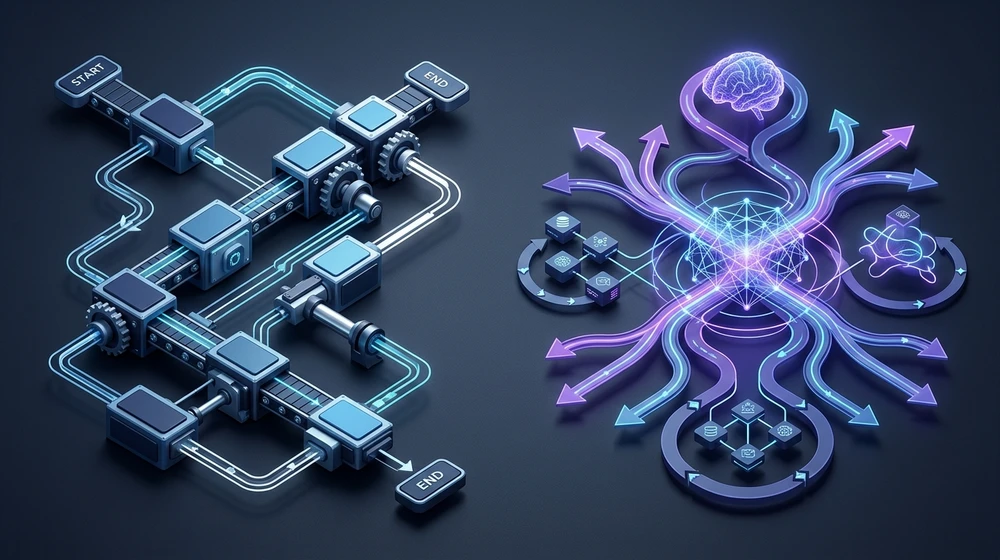
- Workflow automation (Make, Zapier, n8n) follows a fixed path a person designed in advance. It is cheap, fast and predictable, but it stops when a case falls outside that path.
- An AI agent plans its own steps toward a goal and can handle messy, unstructured input, such as free-form emails or WhatsApp messages, that a fixed workflow cannot parse.
- Agents cost more to run and behave less predictably than fixed workflows, so they suit genuinely ambiguous decisions, not tasks that already follow a clear rule.
- Most businesses benefit from combining both: deterministic workflows for the routine steps, with an AI agent handling only the step that needs judgement, inside a reviewed boundary.
Every organization modernizing its operational backbone eventually confronts a pivotal architectural choice: should you build linear workflow automations, or should you deploy autonomous AI agents? While marketing teams frequently conflate both terms under the broad banner of "automation," they represent fundamentally different engineering philosophies, operational boundaries, and cost structures.
Choosing the wrong abstraction leads to costly friction. Forcing deterministic workflow tools like Make, Zapier, or n8n to handle complex, unpredictable edge cases causes fragile pipelines that break at the first unformatted email attachment. Conversely, unleashing open-ended AI agents on rigid, predictable ledger syncing introduces unnecessary token latency, compute expense, and non-deterministic risk. Understanding the technical divergence between linear workflows and cognitive agents enables engineering teams and business operators to allocate capital with precision.
Through our dedicated AI automation agency services, Sivaga Technologies architects hybrid enterprise systems that unite rigid deterministic workflows with cognitive AI agents, delivering scalable, resilient operational efficiency.
Core Architectural Divergence: Determinism vs Autonomous Reasoning
The distinction between workflow automation and AI agents boils down to a single engineering parameter: who plans the execution path?
| Dimension | Workflow Automation (Linear) | AI Agents (Autonomous) |
|---|---|---|
| Execution Path | Predetermined by human developer prior to runtime | Synthesized dynamically by the LLM reasoning core at runtime |
| Decision Logic | Hardcoded conditional logic (IF X THEN Y ELSE Z) | Goal-oriented semantic evaluation and tool invocation |
| Data Compatibility | Rigid structured formats (JSON, database tables, CSV) | Unstructured formats (emails, PDF scans, messy chat logs, voice) |
| Exception Handling | Halts or triggers dead-letter failure queues | Self-corrects, inspects error payloads, and retries alternate tools |
| Cost Model | Low and predictable, billed mainly by platform task volume | Higher and variable, billed by AI model usage and how many reasoning steps a task takes |
In traditional workflow automation, every branch in the flow chart must be explicitly predicted and coded by a human systems builder. If an unexpected condition arises, such as a customer submitting a scanned handwritten note instead of a formatted PDF, the automation throws an unhandled exception and abruptly terminates.
An AI agent, by contrast, operates under a ReAct (Reasoning + Acting) cycle or plan-and-execute loop. Given an ultimate objective like "Review this customer refund claim against company policy and process payment if valid," the agent dynamically assesses the inputs, selects appropriate tools from its capability registry, queries knowledge databases, evaluates confidence levels, and executes actions step by step.
Deep Dive: What Is Workflow Automation?
Workflow automation is the programmatic orchestration of data movement across disparate software applications using predefined triggers and actions. Prominent platforms powering this ecosystem include Make (formerly Integromat), Zapier, n8n, Workato, and Tray.ai.
Key Architectural Characteristics
- Event-Driven Triggers: Execution commences upon a deterministic event, such as a Stripe webhook, a new row in Airtable, a scheduled cron timestamp, or an incoming REST API payload.
- Static Directed Acyclic Graphs (DAGs): Data flows sequentially through interconnected nodes. If Step 2 requires the output of Step 1, the pipeline fails immediately if Step 1 returns empty or misaligned schemas.
- Predictable Execution Costs: Infrastructure costs scale linearly with transaction volume. You know precisely how many operation units a month will cost regardless of the input text content.
- Sub-Second Latency: Because execution avoids token inference and neural weight processing, nodes execute in tens of milliseconds, ideal for real-time synchronization.
When a customer signs an order in DocuSign, immediately extract the PDF, archive it in Google Drive, update the CRM account status to "Closed-Won", ping the Slack billing channel, and trigger an automated onboarding invoice in QuickBooks. Every step is 100% predictable with zero ambiguity.
Deep Dive: What Is an AI Agent?
An AI agent is an autonomous software entity powered by an underlying Large Language Model (such as Claude 3.5 Sonnet, GPT-4o, or Gemini 1.5 Pro) that possesses reasoning agency, persistent memory, tool-calling capabilities, and environmental feedback integration.
Key Architectural Characteristics
- Goal-Oriented Autonomy: Rather than executing a sequence of instructions, the agent receives an overarching objective and dynamically formulates its own execution strategy.
- Dynamic Tool Selection: The agent has access to a registry of API functions (such as CRM lookups, SQL database queries, calculator tools, and email dispatchers). At each step, it decides which tool to call based on real-time observations.
- Self-Correction and Reflection: If a tool returns an error code or an unexpected output, the agent reads the error message, adjusts its parameters, and tries an alternative path without halting.
- Unstructured Context Understanding: Agents excel at parsing human language nuances, fragmented instructions, multi-lingual exchanges, and incomplete inputs.
An incoming procurement email states: "We need 500 custom titanium brackets by Friday, but our shipping port changed to Rotterdam, and we need credit terms matched to contract #849." An AI agent reads the email, verifies inventory in ERP, queries past contracts in vector search, checks credit status, calculates freight rates for the new port, flags edge-case SLA constraints, and drafts a comprehensive approved response for human review.
Direct Comparison Matrix: Capabilities Across Key Dimensions
The following detailed breakdown contrasts both technologies across vital enterprise operational criteria:
| Evaluation Metric | Workflow Automation | AI Agents |
|---|---|---|
| Determinism | 100% deterministic. The identical input always produces the exact identical output path. | Probabilistic. Solves complex problems adaptively, but identical prompts can explore varied reasoning trajectories. |
| Setup Complexity | Low to moderate. Visual canvas builders allow low-code drag-and-drop wiring. | Moderate to high. Requires rigorous prompt engineering, tool schema definitions, evals, and guardrails. |
| Failure Modes | Hard stops on schema mismatches, missing properties, or network 500 errors. | Infinite reasoning loops, tool hallucination, or over-correction if unconstrained by guardrails. |
| Maintenance Burden | High when handling messy data. Every new edge case requires adding another nested IF/THEN router. | Low for edge cases; higher for monitoring model drift, prompt calibration, and API schema changes. |
| Latency | Extremely fast (100ms - 2,000ms for typical multi-step API chains). | Moderate (3s - 45s depending on reasoning steps, RAG searches, and tool response times). |
| Unit Cost | Very low per run, mainly cloud compute time. | Noticeably higher, billed by AI model usage and scales with reasoning steps. |
When to Choose Workflow Automation
You should default to standard workflow automation under the following operating conditions:
- Your Input Data Is Already Structured: If your incoming payload comes from a standardized form submission, a database change data capture (CDC) stream, or a strict REST API webhook, linear pipelines are unmatched.
- The Process Has Zero Ambiguity: If the operational policy can be written down as an exact flow chart with fewer than ten decision branches and no subjective criteria, deterministic workflow code will run faster, cheaper, and with 100% reliability.
- Financial or Legal Compliance Requires Immutable Audit Trails: Financial ledger reconciliation, compliance log syncing, and automated tax calculations must never rely on probabilistic neural networks. They require deterministic mathematics.
- Sub-Second Response Times Are Required: Synchronous user-facing operations (such as validating an SMS OTP or syncing inventory before checkout) cannot afford the multi-second latency of an LLM reasoning cycle.
When to Deploy Autonomous AI Agents
AI agents become essential when business operations hit the "edge-case wall," where traditional automation becomes too fragile or expensive to maintain:
- Unstructured and Ambiguous Customer Interactions: Handling customer escalation tickets where issues range from product inquiries, billing discrepancies, bug reports, and cancellation requests. An agent can research history across databases, determine the root cause, and execute resolution workflows.
- Multi-Source Research and Synthesis: Operations that require collecting competitive pricing intelligence, reading technical spec sheets, cross-referencing industry standards, and preparing executive briefs.
- Dynamic Software Tool Orchestration: Tasks where the exact sequence of actions changes with each request. For example, a code review agent that inspects a pull request, runs security linting tools, analyzes database migration impacts, and proposes targeted code patches.
- Self-Healing and Exception Recovery: In complex workflows where external APIs frequently change parameters, an agent can inspect failure logs, reconstruct correct JSON schemas, and complete operations without human intervention.
The Winning Enterprise Paradigm: Hybrid Workflow-Agent Orchestration
Forward-thinking organizations do not view this decision as an either-or dichotomy. The highest return on investment comes from hybrid architectural orchestration, combining deterministic workflow backbones with cognitive agent brains.
Architecture Pattern: Deterministic Frame, Cognitive Core
In this battle-tested pattern, a workflow engine (such as n8n or Make) handles all deterministic aspects: authenticating webhooks, routing payloads, monitoring rate limits, and persisting audit logs. When the workflow reaches a node requiring subjective judgment, unstructured synthesis, or dynamic tool orchestration, it delegates execution to an AI Agent via an API call.
Once the agent reasons through the problem, verifies its confidence score, and returns a validated JSON object, the workflow engine resumes its fast, cost-effective execution path to update ERPs, dispatch notifications, and close the transaction.
Real-World Example: High-Volume Commercial Underwriting
- Deterministic Step 1 (Workflow): Ingests loan application packet, extracts attachments, checks credit bureau API for credit score cutoff. If score < 580, immediately routes to decline email.
- Cognitive Step 2 (AI Agent): For scores above 580, the agent ingests 100 pages of unstructured bank statements and tax returns, extracts cash-flow metrics, identifies hidden liabilities, cross-examines debt ratios against underwriting rules, and compiles an audit rationale.
- Deterministic Step 3 (Workflow): Validates agent output schema against compliance rules. If approved, dispatches document packet to DocuSign and updates banking ledger.
Evaluation Framework: How to Decide for Your Next Project
Before writing a line of code or signing up for enterprise licenses, run your planned initiative through this four-question diagnostic framework:
- Can you document the exact decision logic in a 1-page flow diagram? If yes, choose Workflow Automation. If the decision tree requires hundreds of conditional branches or contains steps like "use human judgment to understand intent," choose an AI Agent.
- What is the shape of your input data? If strictly structured (JSON/SQL), choose Workflow Automation. If unstructured (prose emails, voice recordings, PDFs, images), use an AI Agent for ingestion.
- What is the cost of non-deterministic variance? If an output must match mathematical precision with zero variance (e.g. payroll taxes), use Workflow Automation. If contextual adaptability is more valuable than rigid repetition, use an AI Agent with validation schemas.
- What is the cost of process failure? If an unhandled exception costs thousands of dollars in lost business, traditional automation may halt too often. An AI agent with self-correction capabilities will maintain higher continuous uptime on ambiguous inputs.
Frequently Asked Questions
Is an AI agent just a more advanced workflow automation?
No. A workflow automation follows a path a person designed before it runs. An AI agent plans its own path at runtime toward a stated goal, which is useful for unstructured input but makes its behaviour less predictable.
Which is cheaper to run, a workflow or an AI agent?
A fixed workflow is usually cheaper and more predictable because it does not call an AI model at every step. An AI agent costs more and the cost varies with how many reasoning steps a task needs, so it suits tasks where that flexibility is actually required.
Can I start with workflow automation and add an AI agent later?
Yes, and this is often the safer order. Many businesses automate the fixed, structured steps first with tools such as Make or Zapier, then add an AI agent only for the one step that genuinely needs judgement, such as reading a free-form message.
Do AI agents need human review?
Yes. An agent can be wrong, so high-stakes or low-confidence decisions should route to a person rather than being treated as automatically correct.
How does Sivaga decide which approach a project needs?
Sivaga starts with the process, not the tool. We map which steps follow a fixed rule and which need judgement, then combine workflow automation and AI agents accordingly. See our AI automation services.
Conclusion: Building Scalable Autonomy
The debate between AI agents and workflow automation is not a contest between old and new technology. Rather, it represents the vital division between mechanical plumbing and cognitive decision-making. Workflow automation provides the high-speed, cost-efficient vascular system of modern digital operations, while AI agents provide the adaptive brainpower needed to resolve complexity.
Organizations that successfully master both layers, deploying deterministic pipelines for routine plumbing and empowering autonomous agents for complex problem-solving, build operational advantages that competitors cannot match.
If you want to know which parts of a process are genuinely fixed rules and which need an AI agent, request a free consultation. Sivaga can help you decide before you build either.
More Guides
- AI automation vs RPA compares cognitive AI with rule-based desktop automation.
- What does an AI automation agency do? explains the stages of a typical project.
Automate Your Inbound Lead Capture 24/7
Deploy conversational web chatbots and automated lead routing systems that qualify visitors and book calls around the clock.
References & further reading