
Key Takeaways
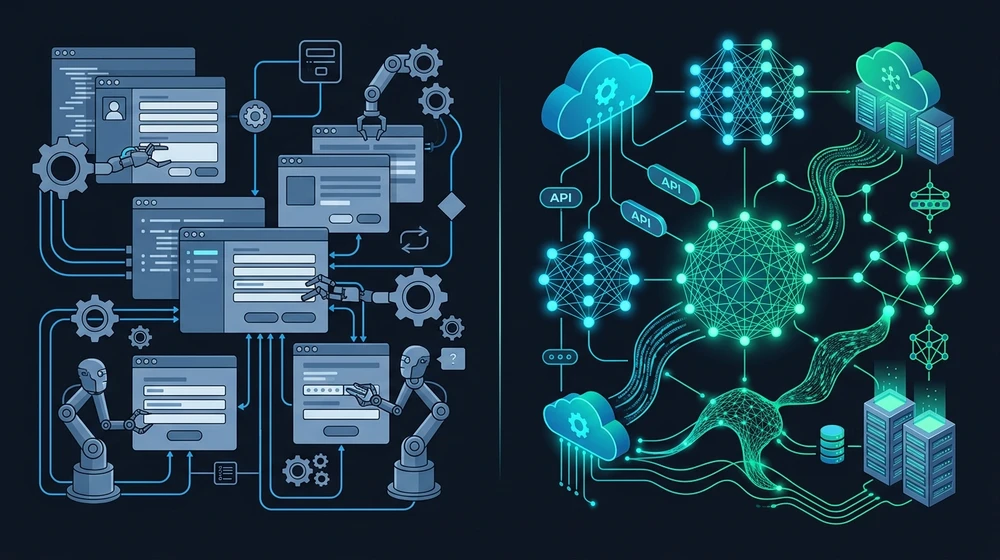
- RPA emulates human clicks and keystrokes on the user interface of legacy desktop systems lacking modern APIs.
- AI automation connects modern systems via cloud APIs while using machine learning models to interpret unstructured data.
- RPA bots are notoriously fragile because minor visual layout shifts or software updates can break screen-recorded steps.
- Modern businesses achieve Intelligent Process Automation (IPA) by pairing cognitive AI decision steps with dependable execution layers.
The core difference between AI automation and Robotic Process Automation (RPA) is how each technology interacts with software: RPA mimics human keystrokes and mouse clicks on user interfaces to move structured data across legacy systems without APIs, whereas AI automation communicates through direct cloud APIs and uses machine learning to interpret unstructured human language, documents, and intent.
For more than a decade, enterprise automation was synonymous with RPA. Corporations invested heavily in software bots from vendors like UiPath, Automation Anywhere, and Blue Prism to automate repetitive desktop chores. These bots acted like digital workers, opening desktop windows, copying fields from spreadsheets, and pasting values into legacy enterprise resource planning (ERP) platforms.
However, the rise of modern cloud software, accessible web APIs, and Large Language Models has fundamentally changed the automation landscape. Today, small and mid-sized businesses can automate complex operations faster and more affordably using API-first AI pipelines rather than deploying expensive, fragile desktop bots.
This comprehensive guide breaks down the technical mechanisms of both approaches, compares their cost profiles, identifies when legacy RPA remains necessary, and explains how to build resilient automation pipelines for your business.
What Is Robotic Process Automation (RPA)?
Robotic Process Automation is software technology that records and mimics rule-based human actions on a computer screen. An RPA bot operates at the presentation layer (the User Interface) rather than the underlying database or application code layer.
If an office clerk spends three hours every morning opening an email attachment, copying an order number, opening a legacy desktop accounting package, navigating three menus, and typing the customer name into a form, an RPA bot can be programmed to mirror those exact physical keystrokes and mouse coordinates.
Core Characteristics of RPA
- User Interface (UI) dependent: The bot interacts with buttons, input fields, dropdowns, and windows exactly as a human employee does.
- Rules-driven and deterministic: The bot follows an exact script. It cannot make subjective judgments or deviate from its predefined path.
- No cognitive understanding: If an invoice lists "Total Cost" instead of "Grand Total", or if a customer writes a handwritten note on a scan, a traditional RPA bot cannot interpret the meaning.
- High maintenance overhead: Because RPA depends on screen coordinates and visual selectors, any application update, changed screen resolution, or altered popup dialogue can cause the bot to fail completely.
What Is AI Automation?
AI automation combines direct cloud and server integrations (via webhooks and REST APIs) with cognitive artificial intelligence capabilities (such as Natural Language Processing, computer vision, and Large Language Models).
Instead of relying on fragile screen clicks, an AI automation pipeline communicates directly between software backends. When a customer inquiry arrives, the pipeline receives the digital data payload instantly, invokes an AI model to evaluate the customer's sentiment, extracts requested product requirements, and writes structured records directly into your database or CRM.
Core Characteristics of AI Automation
- API-first architecture: Operates behind the scenes through structured application programming interfaces, eliminating reliance on open desktop windows or virtual mouse cursors.
- Semantic and cognitive intelligence: Understands unstructured inputs, including varied email wording, conversational WhatsApp chats, messy PDFs, and spoken voice notes.
- Resilience to visual changes: Because communication happens at the API level, changes to website design or user interface layouts never break the underlying workflow.
- Scalable and cloud-native: Runs serverlessly in the cloud or within custom Laravel web applications, processing hundreds of simultaneous transactions without consuming physical desktop workstations.
Head-to-Head Comparison: RPA vs AI Automation
The following table outlines the fundamental technical, operational, and financial differences between both technologies:
| Operational Dimension | Robotic Process Automation (RPA) | Modern AI-Powered Automation |
|---|---|---|
| Interaction Layer | User Interface (UI) screen scraping, clicks, keystrokes | Direct Application Programming Interfaces (APIs) and webhooks |
| Data Suitability | Highly structured, fixed digital forms and tables | Unstructured text, customer emails, PDFs, audio, voice notes |
| Fragility to Changes | High; breaks when a button moves or screen resolution shifts | Low; semantic models adapt to rephrased prompts and format shifts |
| Execution Speed | Limited by desktop UI rendering speeds and delays | Lightning-fast cloud and server-to-server API transactions |
| Licensing & Overhead | Often heavy enterprise bot licenses (e.g. UiPath, Automation Anywhere) | Pay-per-task platforms (Make, Zapier) and micro-token AI model fees |
| Setup Complexity | Requires dedicated virtual machines, bot runners, and screen recorders | Lightweight cloud connectors, serverless webhooks, and custom code |
| Decision-Making Ability | Zero; strictly executes scripted if-then screen steps | Cognitive evaluation, intent classification, sentiment analysis |
| Primary Business Fit | Legacy mainframe systems and desktop ERPs lacking APIs | Modern cloud SaaS stacks, web portals, CRMs, customer messaging |
When Robotic Process Automation (RPA) Remains Necessary
Despite the speed and intelligence of modern AI systems, RPA is not obsolete. It fulfills an essential niche in enterprise architectures where modern software development is blocked by legacy constraints.
1. Legacy Systems Lacking Application Programming Interfaces (APIs)
Many established enterprises, manufacturing plants, and financial institutions in India rely on legacy on-premise ERPs, terminal mainframes, or customized desktop accounting software built decades ago. These systems often have no REST APIs, no database access credentials, and no vendor support. In such environments, RPA screen automation is the only viable method to extract or input data without manually rekeying information.
2. Closed Desktop Applications
If a critical business workflow requires clicking through proprietary desktop software that runs exclusively on local Windows machines with no web version, an RPA bot can bridge the gap by operating the interface during off-hours.
3. Regulatory or Closed Network Constraints
In highly regulated defense or banking sectors where data cannot leave an isolated on-premise local area network, traditional RPA bots running inside locked virtual machines provide automated execution without external internet connectivity.
Why AI Automation Is the Preferred Choice for Modern Businesses
For small and mid-sized enterprises operating primarily on cloud platforms, modern web apps, and digital channels, AI automation is vastly superior to RPA in speed, cost, and reliability.
1. Resilience Against Fragility
The greatest hidden cost of RPA is maintenance. Industry studies frequently show that corporate RPA implementations spend up to 40% of their ongoing budget merely fixing bots that broke due to software updates, modified web layouts, or shifted form fields. In contrast, API-first AI pipelines never break because a button moved. APIs communicate with strict data contracts that remain stable across years.
2. Mastery of Unstructured Customer Data
Modern businesses interact with clients across WhatsApp, email, conversational website chat, and digital forms. Humans do not speak in neat database schemas; they write informal paragraphs, ask compound questions, and send smartphone photos of invoices. RPA cannot process this data. AI automation effortlessly classifies the intent, parses the key dates and amounts, and translates human communication into structured database records.
3. Drastically Lower Total Cost of Ownership
Enterprise RPA platforms demand costly annual bot licenses (often running into hundreds of thousands of rupees per bot runner), dedicated server infrastructure, and specialized RPA developers. Modern AI automation operates on affordable orchestration platforms (such as Make or Zapier) or bespoke custom code, coupled with pay-as-you-go AI model tokens that cost fractions of a rupee per transaction.
Decision Matrix: Evaluating Your Automation Project
Use this evaluation matrix to select the appropriate technology for your operational bottlenecks:
| Operational Challenge | Recommended Solution | Strategic Rationale |
|---|---|---|
| Copying invoice data into a 15-year-old on-premise ERP with no API | Robotic Process Automation | RPA is designed specifically to bridge gaps where programmatic APIs do not exist. |
| Triaging messy customer WhatsApp inquiries and routing to sales | AI Automation | Natural language processing effortlessly interprets varied human phrasing. |
| Extracting line items from varied supplier PDF purchase orders | AI Automation | Vision and document models extract data based on context rather than fixed coordinates. |
| Bulk reconciliations between desktop banking software and local books | Robotic Process Automation | Legacy desktop windows require virtual keystrokes and deterministic data entry. |
| End-to-end e-commerce order intake, CRM creation, and warehouse alerting | AI Automation (Hybrid) | Direct API connections between Shopify, CRM, and logistics tools deliver speed and stability. |
The Convergence: Intelligent Process Automation (IPA)
Rather than viewing RPA and AI as competing alternatives, forward-thinking organizations understand that they represent progressive stages in the automation journey. The ultimate enterprise goal is Intelligent Process Automation (IPA), also known as Intelligent Automation.
When our team at Sivaga designs bespoke systems through our AI automation agency services, we architect solutions that eliminate unnecessary UI scraping wherever modern APIs exist, while pairing cognitive AI evaluation steps with deterministic validation layers.
| Automation Era | Core Technology | Operational Capability | Human Oversight Role |
|---|---|---|---|
| 1. Traditional Scripting | Custom scripts, batch files | Transfers structured files on fixed schedules | Manual exception recovery when scripts fail |
| 2. Robotic Process Automation | UI bot screen recorders | Emulates human desktop clicks across legacy software | Maintains bots when interface layouts update |
| 3. Modern AI Automation | API pipelines, LLMs, webhooks | Understands human intent and routes unstructured data | Reviews edge cases and low-confidence decisions |
| 4. Intelligent Automation (IPA) | RPA bots guided by AI models | Bots execute UI actions based on cognitive AI decisions | Strategic governance, auditing, and process optimization |
A Practical Worked Scenario: Bridging Legacy and Modern Systems
Example (illustration, not a client result):
Consider an established textile distributor in Salem with two conflicting software realities: a modern cloud Shopify e-commerce portal and WhatsApp Business desk for customer orders, paired with an older on-premise desktop accounting and inventory package that has no external API.
- AI Ingestion & Triage: A retail shop owner sends a photo of a handwritten purchase order via WhatsApp. A cloud AI vision model reads the handwritten list, matches the items against product SKUs, and drafts a structured JSON order payload.
- Cloud API Processing: A lightweight cloud webhook updates customer details in the CRM and checks real-time inventory counts through a custom web portal.
- RPA Desktop Bridging: Because the legacy desktop accounting software cannot accept API webhooks, a lightweight scheduled RPA bot running on an office server takes the validated JSON payload, opens the local accounting program, inputs the items, and generates the official state tax invoice.
- Automated Delivery: Once the invoice PDF is generated locally, a cloud trigger captures the file and automatically sends it back to the customer on WhatsApp with an instant payment link.
In this architecture, AI handles the complex language and visual comprehension, cloud APIs handle the communication, and the RPA bot is restricted purely to the single legacy desktop gap where no API exists.
Implementation Best Practices for Business Leaders
To maximize return on investment and avoid costly implementation failures, observe these guidelines:
1. Never Use RPA Where an API Exists
If two software applications offer public REST APIs or webhooks, never build an RPA bot to copy data between their browser screens. Screen automation is a fallback for legacy constraints, never a first choice. Direct API integrations are faster, more secure, and virtually maintenance-free.
2. Keep Cognitive Steps Decoupled from Execution
Structure your workflows so that AI handles interpretation and classification, but programmatic rules handle the actual execution. For instance, let AI read a cancellation request and classify the reason, but use strict deterministic code to process refunds and update billing statuses.
3. Establish Human Review for Edge Cases
Neither RPA bots nor AI models should operate without oversight. Build threshold-based escalation routes: if an AI extraction confidence score falls below 85%, or if an RPA bot encounters an unrecognized popup, the system should hold the transaction and alert an operational team member.
Frequently Asked Questions
Can AI automation completely replace RPA?
AI automation replaces RPA in workflows involving modern web tools, mobile apps, and cloud software with APIs. However, RPA remains necessary for closed legacy desktop applications and on-premise terminal systems that do not support modern programmatic connections.
Why are RPA bots considered fragile?
RPA bots rely on visual selectors, screen coordinates, and graphic user interfaces. If a software vendor updates the layout, changes a button color, moves an input field, or if a screen resolution changes, the bot can fail to locate the target element and halt the entire process.
Is AI automation more expensive than RPA?
No. For small and mid-sized businesses, AI automation is significantly cheaper. Traditional RPA requires expensive enterprise bot licensing and dedicated virtual machines, whereas AI automation leverages affordable cloud connectors and pay-per-token model usage.
What is Intelligent Process Automation (IPA)?
Intelligent Process Automation refers to the combination of traditional robotic task execution with artificial intelligence cognitive capabilities, such as natural language processing, document extraction, and machine learning decision-making.
How does Sivaga help businesses choose between RPA and AI?
Sivaga audits your existing technology stack and business workflows. We help companies eliminate fragile screen scraping by building modern API and AI integrations, connecting legacy systems only where strictly necessary.
Conclusion
Understanding the distinction between AI automation and Robotic Process Automation allows business leaders to deploy the right technology for the right job. RPA remains a valuable stopgap for interacting with legacy desktop software lacking modern connectivity, but AI automation represents the future of business operations: resilient, API-first, and capable of understanding human language at scale.
By shifting from fragile screen scraping to intelligent, API-driven workflows, your enterprise can cut operational friction, eliminate manual data entry errors, and empower your team to focus on strategic growth.
If you want to evaluate your operational workflows and discover whether your business can benefit from modern AI integrations, schedule a free consultation with Sivaga Technologies. Our engineering specialists will assess your systems and outline a dependable, cost-effective automation architecture.
More Guides
- AI Automation vs Traditional Automation: What Is the Difference? compares deterministic rules with cognitive models.
- What Is AI Automation? A Plain-English Guide explains core business automation concepts.
- How AI Automation Works: Triggers, AI Steps and Actions details technical pipeline design.
Automate Your Inbound Lead Capture 24/7
Deploy conversational web chatbots and automated lead routing systems that qualify visitors and book calls around the clock.
References & further reading